In Peru, they’re calling it “vaccine-gate”– discoveries that the then-president, his wife and other well-connected people were covertly inoculated against COVID-19 starting in October, before the Chinese-developed shots were readily available to the public.
The intensifying scandal that broke recently has already forced the resignations of Peru’s foreign and health ministers, amongst nearly 500 people who got so-called courtesy dosages.
” Nothing excuses what I did, much less having covered it up,” stated the previous health minister, Pilar Mazzetti. “I took this choice with the worries and restrictions of a human and I recognize that this was the worst error of my life.”
The vaccine in concern was produced by Sinopharm, among several Chinese companies strongly marketing COVID-19 vaccines throughout Latin America
Peruvian federal district attorneys and a congressional commission are examining how the Sinopharm shots ended up allocated to a fortunate few as COVID-19 damaged the country of 32 million. The federal government has launched few details about the agreement– it is not publicly known just how much Peru paid the bulk state-owned business– fanning speculation about a vaccines-for-favors scheme that avoided non-Chinese providers.
The Chinese Embassy in Lima has actually denied any impropriety on its part and stated it “declined making use of terms like courtesy vaccinations, contributions or advantages.”
Apart from the scandal, Sinopharm’s main function in Peru’s vaccine rollout highlights the broad reach of China in the Americas. Even before the pandemic, China had actually ended up being an economic colossus in the region, usurping the United States as chief trading partner to Peru, Brazil and other nations. In Peru, China is an imposing force in mining, electrical power generation and infrastructure tasks, including the building and construction of a brand-new deep-water port.
Taking on COVID-19 to broaden its global influence, China has actually become a significant player in the vaccine sweepstakes– particularly in Latin America.

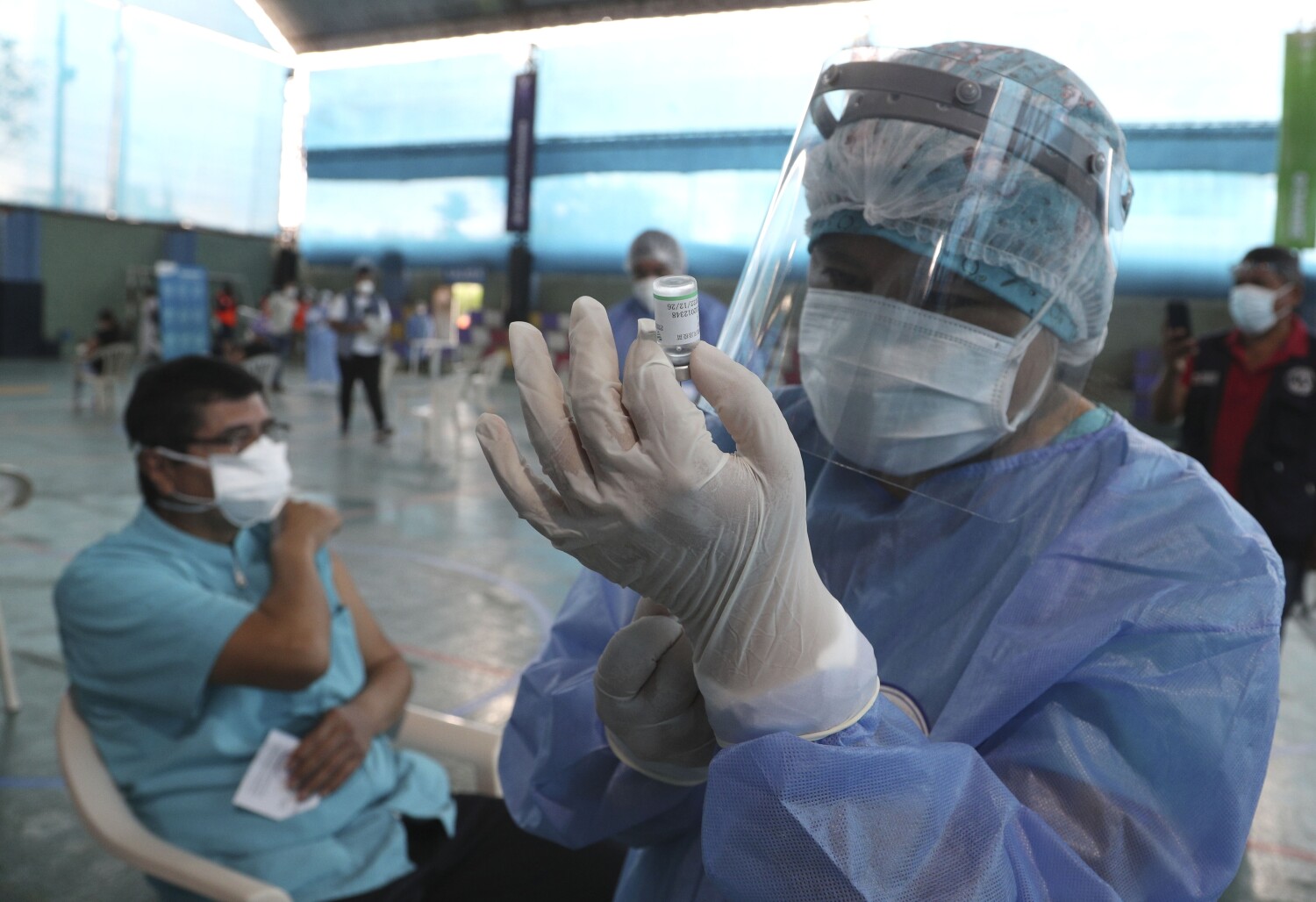
A physician gets a COVID-19 vaccine made by China’s Sinopharm at a public healthcare facility in Lima, Peru, on Feb. 9, 2021.
( Martin Mejia/ Associated Press)
Brazil, Chile and Mexico are also relying greatly on Chinese vaccines.
The Chinese shots have actually had to conquer substantial preliminary public suspicion compared with greatly hyped Western rivals such as the one from U.S.-based Pfizer and Germany-based BioNTech.
” The Pfizer vaccine was better known,” stated Carla Aravena, a 27- year-old English instructor in the Chilean capital of Santiago, who wavered on whether to get a shot made by the Chinese company Sinovac prior to going on with it. “However then I stated to myself, ‘If the Chinese have such an obvious issue, they must have optimized their efforts to get a great outcome.’ “
In Mexico, President Andrés Manuel López Obrador has actually revealed aggravation with the U.S. stranglehold on production.
” In the United States they have control of all the vaccines that they establish,” he informed reporters this month, pointing to a chart showing that numerous cash-strapped nations had yet to receive a single dosage. “Our case, which of Latin America, is various.”
Mexico launched its vaccine rollout with great fanfare late last year after a preliminary shipment of Pfizer-BioNTech shots. But Pfizer suspended deliveries to Mexico for 3 weeks after its production plant in Belgium– for non-U.S. customers– faced a logjam.
Quickening to protect shots any place they can, Mexican authorities have pinned high hopes on CanSino Biologics, another Chinese pharmaceutical attire. Mexico employed about 15,000 volunteers for late-stage trials of the CanSino vaccine, which had been at first tested on Chinese military personnel. The country also has an offer to bundle 35 million doses of Cansino’s formula at a plant outside Mexico City.
In medical trials, Chinese vaccines have not approached the 90%- plus efficiency in avoiding signs that was achieved in tests of shots from Pfizer-BioNTech and the U.S. company Moderna– though experts say it is hard to make such contrasts since trial conditions were not standardized
Brazilian President Jair Bolsonaro initially derided Chinese formulas as harmful.
Like Brazil, Peru was slow to begin inoculating individuals.
Peru opted for Sinopharm, an offer revealed last month that guarantees to provide 38 million dosages, enough to inoculate majority its population.

President Francisco Sagasti is among the very first Peruvians to get the Chinese vaccine publicly. He got his shot in a media-hyped display suggested in part to stop doubts about the Chinese product.
( Rodrigo Abd/ Associated Press)
The country started its vaccination campaign this month after getting its very first million doses. Among the very first to get the Chinese vaccine openly was President Francisco Sagasti– in a media-hyped display meant in part to quell doubts about the Chinese product.
Within days, however, the feel-good minute faded as the vaccine-gate story struck the headings. Journalism ultimately reported that political figures, university chiefs, diplomats and others– including the driver of the previous health minister– had been covertly given the shot during late-stage trials for Sinopharm.
Astete resigned as foreign minister Saturday after admitting to what she called the “grave error” of being inoculated with the Chinese vaccine prior to its public release.
The disclosures sparked extensive outrage even in Peru, a nation deeply inured to political scandal– 6 of its last 7 presidents have either been required from workplace in the middle of accusations of misdeed or faced charges upon completing their terms.
It turned out, the existing president stated, that 487 individuals were “irregularly” given the Sinopharm vaccine.
Not every recipient was a political expert– some simply got lucky.
Times staff author McDonnell reported from Mexico City and unique correspondent León from Lima.


No comments:
Post a Comment